Search is changing faster than ever. A few years ago, whenever we needed information, we opened Google, typed a keyword and visited a few websites to find the answer. Today, people are also asking questions directly to AI platforms like ChatGPT, Gemini and Perplexity.
Even Google is changing how it presents information through AI-powered search experiences.
As a Web Developer and SEO Specialist, I believe that simply building a good-looking website is no longer enough. Your website needs to be technically strong, easy to discover, helpful to readers and understandable to AI-powered systems.
This is where Search Engine Optimization (SEO), Answer Engine Optimization (AEO) and Generative Engine Optimization (GEO) come into the picture.
But what exactly is the difference between these three strategies? Do businesses need all of them? And is traditional SEO still relevant?
Let’s understand each concept with practical examples.
SEO vs AEO vs GEO: What is the Difference?
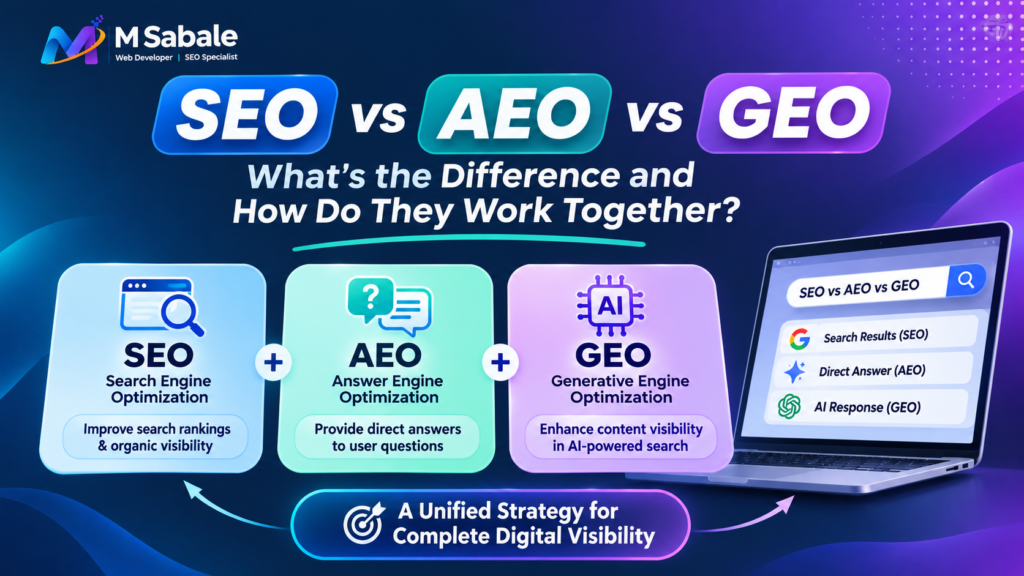
SEO vs AEO vs GEO: SEO helps your website appear in traditional search results, AEO helps your content provide direct answers to user questions, and GEO focuses on improving your content’s visibility within generative AI-powered search experiences.
Think of it this way:
- SEO: Helps people find your website.
- AEO: Helps people find answers within your content.
- GEO: Helps AI systems discover, understand and potentially reference your content.
Although their approaches differ, their ultimate goal is the same — connecting the right audience with the right information.
What is SEO (Search Engine Optimization)?
Search Engine Optimization is the process of improving a website to increase its visibility in organic search engine results.
Imagine you run a small business offering website development services in Pune. When someone searches for “web developer in Pune,” you naturally want your website to appear among the relevant search results.
SEO helps you work towards that goal.
However, SEO is not simply about adding keywords to a website. It involves understanding your audience, improving website performance, creating useful content and building credibility over time.
Key Components of SEO
Technical SEO
Technical SEO focuses on the technical health of your website.
A website may have excellent content, but if search engines struggle to crawl or index its pages, that content may never reach its intended audience.
Technical SEO includes website loading speed, mobile responsiveness, XML sitemaps, canonical tags, website security, Core Web Vitals and crawlability.
A strong technical foundation benefits both search engines and website visitors.
On-Page SEO
On-Page SEO focuses on improving individual website pages.
This includes optimizing page titles, meta descriptions, headings, images, internal links and content according to the user’s search intent.
The objective is not to repeat keywords unnecessarily but to make every page useful, relevant and easy to understand.
Off-Page SEO
Off-Page SEO involves building your website’s credibility beyond your own website.
Quality backlinks, relevant brand mentions, industry references and professional profiles can contribute to establishing a stronger digital presence.
Content SEO
Good content remains one of the most important elements of SEO.
Instead of writing articles just to target keywords, businesses should focus on solving real problems, answering customer questions and sharing meaningful information.
A helpful article that genuinely addresses a user’s needs has more long-term value than content created only for search rankings.
For a better understanding of SEO fundamentals, explore the official Google SEO Starter Guide.
What is AEO (Answer Engine Optimization)?
Have you ever searched for a question on Google and found the answer without visiting a website?
That experience helps explain the importance of Answer Engine Optimization.
AEO is the practice of creating and structuring content so that search engines and answer platforms can easily identify relevant answers to user questions.
People increasingly search using natural questions rather than short keywords.
For example, instead of searching for “technical SEO,” someone might ask:
- What is Technical SEO?
- Why is Technical SEO important?
- How can I improve my website’s SEO?
- What is the difference between Technical SEO and On-Page SEO?
These questions represent specific information needs.
AEO focuses on answering them clearly and directly.
How Does AEO Work?
Suppose you are writing an article about website development.
Instead of beginning with several paragraphs of unnecessary background information, you could answer the main question immediately.
What is responsive web development?
Responsive web development is the process of creating websites that automatically adjust their layout, content and functionality according to different screen sizes, including desktops, tablets and smartphones.
This answer is straightforward, useful and easy to understand.
You can then provide additional explanations, examples and practical recommendations.
Best Practices for AEO
- Use natural, question-based headings.
- Provide direct answers before detailed explanations.
- Include relevant FAQs.
- Use comparison tables where appropriate.
- Break complex information into simple steps.
- Maintain a clear heading structure.
- Implement relevant structured data.
The idea is simple: make your content easier for people to understand and easier for automated systems to interpret.
What is GEO (Generative Engine Optimization)?
Generative Engine Optimization is an emerging approach to improving content discoverability within generative AI-powered search systems.
Unlike traditional search engines that primarily display links, generative AI platforms can combine information from different sources and present it as a conversational response.
For example, a business owner might ask an AI platform:
What should I consider before hiring a web developer and SEO specialist for my business?
Instead of receiving only a list of websites, the user may receive a detailed explanation covering website performance, technical expertise, mobile responsiveness, SEO experience and business requirements.
Depending on the platform and its retrieval capabilities, the response may also include references to relevant websites.
GEO focuses on improving the chances that your content can be discovered, understood and considered as a useful source within these experiences.
You can learn more about this concept through the Generative Engine Optimization research paper.
What Makes Content Suitable for GEO?
Clear and Accurate Information
Your content should explain concepts properly rather than relying on vague statements or promotional language.
If you are discussing Technical SEO, explain what it involves, why it matters and how businesses can implement it.
Credible Sources
Supporting important claims with reliable sources makes your content more useful and trustworthy.
Official documentation, industry research, practical examples and original insights can strengthen your content.
Entity Optimization
An entity can be a person, business, product, service, organization or identifiable concept.
For a personal portfolio website, it is important to clearly establish who you are, what services you provide and which topics you specialize in.
For example, my professional identity as M Sabale connects with Web Development, Technical SEO, On-Page SEO, AEO, GEO and Digital Marketing.
Maintaining these relationships consistently across a website and professional profiles helps establish a clearer digital identity.
Original Experience and Expertise
There is already a huge amount of repetitive content available online.
Sharing practical experiences, real challenges, original observations and meaningful examples can make your content more valuable.
Rather than simply repeating what other websites say, explain what businesses should actually do and why.
SEO vs AEO vs GEO: Key Differences
| Feature | SEO | AEO | GEO |
|---|---|---|---|
| Full Form | Search Engine Optimization | Answer Engine Optimization | Generative Engine Optimization |
| Main Objective | Organic search visibility | Direct answers | AI search visibility |
| Primary Focus | Rankings and relevance | User questions | Context and credibility |
| Content Approach | Optimized website pages | Clear and structured answers | Evidence-based content |
| Search Experience | Traditional search results | Answer-based search | Generative AI responses |
| Key Metrics | Clicks, rankings and impressions | Answer visibility and engagement | AI mentions, citations and referrals |
| Common Foundation | Helpful content | Helpful content | Helpful content |
The important thing to understand is that these strategies are not competitors. They complement each other.
How Do Search Engines and AI Systems Discover Information?
To understand why these optimization strategies matter, we first need to understand how online information is discovered.
Traditional Search Engines
Search engines such as Google and Bing use automated systems to discover website pages, process their content and index eligible information.
When someone performs a search, ranking systems evaluate relevant information and display results.
A technically accessible website with helpful content has a better foundation for competing in organic search.
Answer Engines
Answer engines focus on understanding questions and identifying relevant information that satisfies the user’s requirements.
Well-organized headings, clear definitions and direct explanations can make content easier to interpret.
Generative AI Systems
Generative AI systems work differently depending on the platform.
Some rely on previously learned information, while others use live web search, external information retrieval or a combination of these methods.
When web retrieval is available, AI systems may select information from relevant sources and synthesize it into a response.
This is why website accessibility, content quality, source credibility and contextual relevance matter.
However, no optimization technique can guarantee that a particular AI system will recommend or cite your website.
For additional information, refer to Google’s official documentation on AI features and your website.
How SEO, AEO and GEO Work Together
Consider a business that provides industrial HVAC services and wants to improve its online visibility.
The business publishes an article titled “How Industrial HVAC Systems Improve Energy Efficiency.”
Here’s how the three strategies could work together.
SEO: The article uses relevant keywords, optimized headings, internal links, fast-loading images and a technically accessible website structure.
AEO: The article directly answers questions such as “How does industrial HVAC reduce energy consumption?” and “What are the benefits of energy-efficient HVAC systems?”
GEO: The article includes credible industry references, practical engineering examples, accurate technical explanations and clearly identified business expertise.
The result is a single article designed to serve traditional search users, people looking for direct answers and AI-powered information discovery systems.
You do not necessarily need three separate articles for three different optimization strategies.
You need one genuinely useful piece of content supported by a strong technical foundation.
How to Optimize Your Website for SEO, AEO and GEO
1. Start with a Technically Strong Website
Before investing heavily in content marketing, make sure your website works properly.
Check its loading speed, mobile responsiveness, navigation, security and indexing status.
Tools such as Google Search Console and PageSpeed Insights can help identify areas that need improvement.
2. Understand What Your Audience Actually Wants
Keyword research is important, but understanding search intent is equally important.
Ask yourself what the visitor expects to learn, what problem they are trying to solve and what information would help them make a better decision.
Create content around those requirements rather than focusing only on keyword search volumes.
3. Write for People First
One of the biggest mistakes businesses make is creating content exclusively for search engines.
Long articles filled with repeated keywords do not automatically provide value.
Write naturally. Use simple language where possible. Explain technical concepts with examples and remove unnecessary information.
Your readers should feel that the article was written to help them, not just to attract website traffic.
4. Build Topical Authority
Instead of publishing random articles on unrelated subjects, create a collection of connected content around your expertise.
For example, a website focused on SEO services could publish dedicated guides on Technical SEO, On-Page SEO, AEO, GEO, structured data and AI search optimization.
Connecting these articles through relevant internal links helps visitors explore related topics and gives search systems a clearer understanding of your website’s subject matter.
5. Demonstrate Experience and Expertise
Google’s E-E-A-T framework emphasizes Experience, Expertise, Authoritativeness and Trustworthiness.
Businesses can demonstrate these qualities by publishing accurate information, introducing their authors, sharing genuine case studies, providing credible references and maintaining transparent contact information.
Trust is not something that can be created by adding a few keywords. It develops through consistent, reliable and useful information.
6. Use Structured Data Appropriately
Structured data helps search systems understand the information and relationships presented on a website.
Depending on your website, you can implement Article, Person, Organization, BreadcrumbList and other relevant schema types.
However, schema markup should support your existing content rather than replace it.
It is not a shortcut to higher rankings or AI-generated citations.
Learn more through Google’s structured data documentation.
7. Monitor Your Website Performance
Optimization is an ongoing process.
Monitor organic traffic, search impressions, keyword performance, user engagement, conversions and AI referral traffic where available.
You can use Google Search Console, Google Analytics 4 and other relevant tools to understand what is working and where improvements are needed.
Will GEO Replace Traditional SEO?
This is one of the most common questions surrounding AI search.
In my view, businesses should not abandon traditional SEO simply because AI-powered search is growing.
SEO remains an important foundation for website discoverability. AEO improves the accessibility of answers, while GEO expands the strategy towards generative AI experiences.
A website that is slow, difficult to navigate, poorly structured or filled with unreliable information will not become successful simply by implementing GEO techniques.
The fundamentals still matter.
What is changing is how people discover and consume information.
Businesses that adapt to these changes while maintaining strong SEO practices will be better positioned for the evolving digital landscape.
Frequently Asked Questions
What is the Main Difference Between SEO, AEO and GEO?
SEO focuses on improving organic search visibility, AEO focuses on providing direct answers to user questions, and GEO focuses on content discoverability within generative AI-powered search experiences.
Is Traditional SEO Still Important?
Yes. Traditional SEO remains important for website discoverability, organic traffic, technical accessibility and long-term digital visibility.
Can I Implement SEO, AEO and GEO on the Same Website?
Absolutely. These strategies complement each other and can be implemented through technically optimized websites, helpful content, clear answers and credible information.
How Can I Optimize My Website for ChatGPT and Other AI Platforms?
Focus on publishing original, accurate and well-structured content. Maintain technical accessibility, provide credible references and establish a consistent professional or business identity. AI visibility and citations cannot be guaranteed.
Is GEO a Ranking Factor?
GEO is an optimization approach, not a single confirmed ranking factor. Different generative AI systems use different methods to discover, retrieve and present information.
Does AEO Require FAQ Schema?
No. FAQ schema can help describe relevant content, but clear answers and well-structured information are more fundamental. Schema alone does not guarantee answer visibility.
How Long Does SEO, AEO and GEO Take to Show Results?
There is no fixed timeline. Results depend on website quality, competition, content relevance, technical performance, platform capabilities and consistency of optimization efforts.
SEO vs AEO vs GEO: Final Thoughts
The future of search is not about choosing between SEO, AEO and GEO. It is about understanding how these approaches can work together.
SEO helps your website get discovered. AEO helps your audience find answers. GEO helps your content become more suitable for discovery within AI-powered search experiences.
But regardless of how technology evolves, one principle remains unchanged: create something genuinely useful for your audience.
A technically strong website, helpful content and a trustworthy digital identity are the foundations of sustainable online visibility.
Businesses that focus on these fundamentals while adapting to new search technologies can build a stronger and more future-ready digital presence.
Let’s Build a Smarter Digital Presence
I’m M Sabale, a Web Developer and SEO Specialist passionate about creating responsive, user-friendly websites and helping businesses improve their online visibility.
My approach combines Web Development, Technical SEO, On-Page SEO, AEO and GEO to help businesses build a digital presence that serves both today’s users and emerging search experiences.
Whether you are planning a new website or looking to improve your existing one, I can help you develop a strategy aligned with your business goals.
Build Better. Rank Smarter. Grow Digitally.